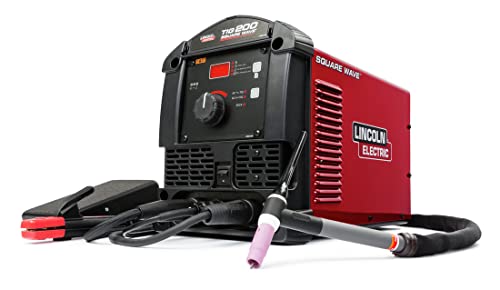
The Lincoln Electric Square Wave TIG 200 is a dedicated AC/DC TIG and stick welder. Lincoln’s literature describes it as a machine that lets hobbyists, small fabricators and craftsmen expand their welding skills, with smooth, stable AC TIG on aluminum and DC TIG on steel, stainless steel and chrome-moly. There is no wire feeder and no MIG gun. What you get instead is a compact 46 lb inverter that plugs into 120 V or 230 V and gives you the controls you need to shape an aluminum weld. Our welder ranking for 2026 places it fourth, as the TIG specialist among mostly MIG and multiprocess machines.
Specs come from Lincoln’s Square Wave TIG 200 spec sheet (publication E3.38.1) and the operator’s manual, hosted on Lincoln’s own document server, not from Amazon listings. We do not publish prices; the button at the end shows current pricing on Amazon.
Key Specs According to Lincoln
- Processes: AC/DC TIG and DC stick.
- Input: 120 V or 230 V, single phase.
- TIG output range: 10 to 125 A on 120 V; 10 to 200 A on 230 V.
- TIG rated output on 120 V: 125 A at 25% duty cycle, 100 A at 40%, 85 A at 60%. Lincoln footnotes AC TIG at 110 A for the 25% rating.
- TIG rated output on 230 V: 200 A at 25%, 160 A at 40%, 130 A at 60%.
- Stick output range: 10 to 90 A on 120 V; 10 to 170 A on 230 V. Rated 75 A at 20% and 65 A at 60% on 120 V; 170 A at 20% and 100 A at 60% on 230 V.
- AC controls: frequency 60 to 150 Hz, balance 60 to 90% electrode negative, and pulse 0.1 to 20 pulses per second.
- Arc start: high frequency.
- Size and weight: 14 inches high, 10.75 inches wide, 19.25 inches deep, and 46 lb.
Duty cycle here is measured over a ten-minute period. A 60% rating means six minutes of welding and four minutes of rest at that output. The machine’s thermal protector shuts the output off if you exceed it and restores it once the machine cools.
What the AC Controls Do
Aluminum needs AC because the oxide layer on its surface must be cleaned away while the metal underneath is melted. Lincoln’s spec sheet explains the controls in plain terms:
- AC frequency. A lower frequency gives a wider bead; a higher frequency gives a more focused bead. Welders often raise it for tight corners and thin material.
- AC balance. A lower percentage of electrode negative gives more cleaning action. A higher percentage gives more penetration.
- Pulse. A lower pulse frequency helps moderate filler metal deposition; a higher one helps manage heat input and reduce distortion.
These are the same adjustments you find on the Multimatic 220 AC/DC, where they are paired with MIG and an auto-set function. Here there are fewer extras and the focus is on the TIG arc itself.
What Is in the Box
Lincoln lists a PTA-17 series 150 A air-cooled TIG torch with a flexible head and Ultra-Flex cable and parts, a foot Amptrol, a regulator and flowmeter with gas hose, a stick electrode holder, a ground clamp and 120/230 V input cords. Key accessories listed include a utility cart, a hand Amptrol and other PTA torches. Shielding gas is not listed in the package, so plan on a cylinder of argon.
Aluminum, Steel and Stainless
For aluminum, Lincoln lists AC TIG on the machine, and the operator’s manual shows a table of suggested amperage by thickness for aluminum and for stainless steel. The tungsten guide in the manual lists zirconiated tungsten as a very good choice for aluminum or magnesium and says pure tungsten is not recommended. For steel, stainless and chrome-moly you switch to DC TIG.
Stainless steel brings a fume warning. OSHA’s welding fume fact sheet says chromium is converted to its hexavalent state during welding, so use ventilation or local fume extraction when you weld stainless. OSHA also says welding outdoors does not guarantee adequate ventilation.
Strengths
- Real AC control in a compact package. Frequency, balance and pulse give you what you need to shape aluminum welds.
- Complete TIG kit. The torch, foot Amptrol and regulator are included, so you can begin once you have gas and tungsten.
- Stick as a bonus. Lincoln lists stick for outdoor work and thicker material.
- Portable. At 46 lb it weighs less than the Lincoln POWER MIG 215 MPi (48 lb) and the Miller Multimatic 220 AC/DC (56 lb), and more than the AHP AlphaTIG 203Xi (40 lb).
Limits
TIG and stick only. There is no wire feeder, so production-style steel welding with MIG is out. Our Millermatic 211 PRO or Lincoln POWER MIG 215 MPi cover that.
Lower output on 120 V. Lincoln’s 120 V rating is 125 A at 25% for TIG and 110 A for AC TIG. That is workable for sheet and light aluminum, but 230 V is the better home for thicker pieces.
TIG is slow. TIG gives the best bead appearance and control, but it takes cleaning, practice and patience. Miller says MIG is the easier process to learn.
Weather. Lincoln’s manual says the machine should not be subjected to rain or snow, so keep it in a dry, sheltered area.
Power and Safety
The machine connects to 120 V or 230 V. A new 230 V receptacle or circuit is installed by a licensed electrician, and the manufacturers of similar machines say the same about connecting power, so do not improvise one. We do not give wiring, breaker or wire-gauge instructions.
Welding hazards apply. OSHA’s 1910.133 requires eye and face protection meeting ANSI Z87.1 and a filter shade appropriate to the work, so wear an auto-darkening helmet rated for TIG and safety glasses. Wear flame-resistant gloves and clothing, and clear flammables from the area as OSHA’s fire prevention rules in 1910.252 describe. Lincoln’s manual also has a section on machine grounding and high frequency, noting that the high frequency generator is similar to a radio transmitter, so follow Lincoln’s installation guidance.
Who It Fits
- Aluminum projects such as boat parts, bike frames, trailer pieces and automotive fabrication.
- Hobbyists who want to learn TIG on steel and stainless as well.
- Small fabricators who already own a MIG machine and want to add TIG.
It is a weaker fit for beginners who only want to join steel quickly. If you want the one-machine route, read the Miller Multimatic 220 AC/DC profile, which adds MIG, flux-cored and stick to AC TIG.
Sources