We earn a commission if you buy through our links, at no extra cost to you.
Best Welder for Aluminum: AC TIG or Spool Gun?
How to weld aluminum at home: AC TIG vs MIG with a spool gun, thickness limits, 100% argon, and which welders on our list do each, with three AC TIG picks.
At a glance
For aluminum, choose AC TIG or a MIG machine with a spool gun and 100% argon, which Miller says suits 14 gauge and heavier. The Miller Multimatic 220 AC/DC does AC TIG and MIG in one machine. The Lincoln Square Wave TIG 200 and AHP AlphaTIG 203Xi are dedicated AC TIG machines.


Aluminum can send first-time buyers straight to the wrong machine. A welder that does a fine job on steel can be unable to weld aluminum at all, or only with an accessory that is not in the box. Two methods work at home: AC TIG, and MIG with a spool gun. This guide explains the difference, the limits that matter (thickness, gas, cleanliness), and which machines on our list do each. For the full field, see our welder ranking.
Specs here come from the makers’ pages and manuals and from Miller’s welding guides. We do not list prices; use the Amazon buttons to see current pricing.
Why Aluminum Is Different
Miller’s guide to MIG welding aluminum describes it as a soft metal that is alloyed for strength, with unique challenges: distortion and sensitivity to heat input. The metal must be thoroughly cleaned, including removing lubricants, then the oxide removed with a stainless wire brush kept only for aluminum. Miller also says aluminum needs 100% argon shielding gas, at 20 to 30 cubic feet per hour, because it is nonferrous.
Those requirements already rule some welders out. A gasless flux-cored machine like the Lincoln WELD-PAK 90i FC is a steel tool as Lincoln describes it, and a gas MIG welder without a spool gun is a steel tool in practice.
Route 1: AC TIG
In Miller’s TIG guide, DC TIG is commonly used for steel and stainless steel, while AC TIG is only used for aluminum. Aluminum forms a tough oxide layer, and AC lets the welder clean the surface and still get proper penetration. The same guide warns that the oxide can shimmer and move before the base metal melts, which makes the puddle harder to read at first, and that the puddle is fluid and heat moves quickly through the metal.
AC TIG is the route for thin aluminum. Miller says aluminum thinner than 14 gauge may need pulsed MIG or AC TIG, and its sheet metal guidance recommends an inverter-based power source for thin aluminum, because it lets you use a pointed ceriated tungsten rather than a balled pure tungsten. It is also the slower, harder process: Miller calls TIG comparatively more complex and difficult to master and significantly slower.
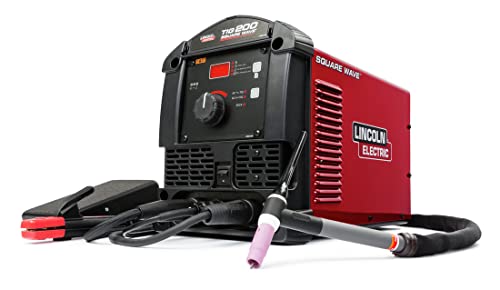
Only three machines on our list do AC TIG: the Miller Multimatic 220 AC/DC, the Lincoln Electric Square Wave TIG 200 and the AHP AlphaTIG 203Xi.
Miller Multimatic 220 AC/DC: One Machine for MIG and AC TIG
The only machine on our list that does MIG, flux-cored, stick, DC TIG and AC TIG, so one purchase covers steel and aluminum work.
Miller lists the Multimatic 220 AC/DC as a 120V/240V multiprocess welder that does MIG, flux-cored, stick, and AC/DC TIG. Its spec sheet lists AC/DC TIG from 24 gauge to 1/4 in. in steel and aluminum, and aluminum MIG from 18 gauge to 3/8 in. AC balance adjusts from 60 to 80% and AC frequency from 60 to 150 Hz. It uses high-frequency, non-contact arc starts. Miller includes a TIG torch and a foot control, and weighs 56 lb. The spool gun for aluminum MIG is not included; Miller sells the Spoolmate 100 and 150 spool guns separately. Details are in our Multimatic 220 AC/DC profile.
Lincoln Electric Square Wave TIG 200: A Dedicated AC TIG Machine
A 120V/230V AC/DC TIG and stick welder from Lincoln, for readers who want clean-looking aluminum beads and do not need MIG.
Lincoln describes the Square Wave TIG 200 as a great TIG machine for aluminum, with high-frequency starting, adjustable arc width and built-in settings for more cleaning action. Its spec sheet lists 10 to 125A TIG on 120V and 10 to 200A on 230V, a net weight of 46 lb, AC frequency of 60 to 150 Hz, AC balance of 60 to 90% electrode negative, and a pulse range of 0.1 to 20 pulses per second. It also does stick. See the Square Wave TIG 200 profile for details.
AHP AlphaTIG 203Xi: The Pulse AC/DC Option
A 120V/240V AC/DC pulse TIG and stick welder with a foot pedal, for someone who has chosen TIG and is ready for the learning curve.
AHP lists 200A TIG output at a 60% duty cycle on 240V, AC frequency from 20 to 200 Hz, AC balance from 20 to 80% electrode positive, pulse on AC and DC, and a 40 lb weight. A Nova foot pedal and TIG torch are listed as included. AHP’s manual says its TIG products are designed for users with a professional knowledge base, so this is not a first-welder pick. See the AlphaTIG 203Xi profile.
Route 2: MIG With a Spool Gun
Miller says aluminum thicknesses suitable for MIG are 14 gauge and heavier, with spray transfer as the desired mode. Aluminum wire is soft and tends to tangle in a long gun liner, so it is commonly fed with a spool gun or a push-pull system. A spool gun carries a small spool on a pistol-grip gun, so the wire feeds only a few inches, which Miller says removes the possibility of bird-nesting.
Which machines on our list take a spool gun, according to the makers:
- Millermatic 211 PRO: Miller lists aluminum MIG from 18 gauge to 3/8 in. with a Spoolmate 100 or 150 spool gun, sold separately, and Auto Spool Gun Detect. Its pulsed MIG rating is 18 gauge to 1/8 in. aluminum. See the Millermatic 211 PRO profile.
- Lincoln Electric POWER MIG 215 MPi: Lincoln’s manual says welding aluminum requires the Magnum Pro 100SG spool gun, and the machine is spool gun ready. Lincoln’s product sheet lists an Aluminum One-Pak version, so check which kit the listing includes. See the POWER MIG 215 MPi profile.
- Hobart Handler 210i: Spool gun ready, with aluminum from 18 gauge to 1/4 in. in Hobart’s table and the SpoolRunner 100 as the plug-in spool gun. See the Handler 210i profile.
- Hobart Handler 140EZ: Spool gun ready, with the SpoolRunner 150 listed. It is a 120V machine rated at 90A and a 30% duty cycle, so plan on thinner work.
Do not count on the spool gun being in the box. In every case above it is a separate purchase. Miller’s Multimatic 220 AC/DC page, for example, lists the spool gun for aluminum MIG as not included, and Hobart’s 210i page lists the SpoolRunner as an accessory.
Which Route Should You Pick?
- You want thin aluminum, car or boat trim, or clean-looking beads: AC TIG. The Multimatic 220 AC/DC covers this and MIG for steel, while the Square Wave TIG 200 and AlphaTIG 203Xi are TIG specialists.
- You weld mostly steel and occasionally 1/8 in. and thicker aluminum: a spool gun on a MIG machine you already like, such as the 211 PRO, 215 MPi or Handler 210i.
- You are brand new to welding: learn steel first. Miller says MIG is the easiest process to learn, and TIG takes more practice. See the beginner guide.
Technique, Cleaning, and Safety
Miller’s MIG aluminum tips include a 10 to 15 degree push travel angle, a contact tip recessed about 1/8 in. inside the nozzle, no drag angle (which gives porous, dirty welds), straight multi-pass beads instead of big weaves, and a faster travel speed as the metal heats. Miller names ER4043 and ER5356 as the two most readily available aluminum filler wires.
Safety rules apply as for any welding. OSHA requires eye and face protection that meets ANSI Z87.1 (29 CFR 1910.133), with a filter lens shade suited to the work (1910.252). Use an auto-darkening helmet, flame-resistant gloves and clothing, and keep flammables away. OSHA says welding outdoors does not guarantee adequate ventilation, so use local fume extraction, and note that welding fume contains metals such as aluminum. Shielding gases such as argon displace oxygen, which is a hazard in confined spaces. Any new 240V receptacle should be installed by a licensed electrician.
Bottom Line
Aluminum needs AC TIG or a spool gun, and 100% argon either way. The Miller Multimatic 220 AC/DC is the all-in-one answer among our picks, and the Lincoln Square Wave TIG 200 and AHP AlphaTIG 203Xi are TIG-only choices. If most of your work is steel, a MIG machine with a spool gun may cover your aluminum. Compare everything in our welder ranking.
Sources
- Miller: How to Successfully MIG Weld Aluminum
- Miller: Getting Started With TIG Welding, MIG vs TIG
- Miller: Successfully Welding Sheet Metal with MIG and TIG
- Miller: Buying Your First Welder
- Miller Multimatic 220 AC/DC official product page
- Miller Multimatic 220 AC/DC spec sheet
- Millermatic 211 PRO official product page
- Millermatic 211 PRO spec sheet
- Lincoln Electric Square Wave TIG 200 spec sheet (E3.38.1)
- Lincoln Electric POWER MIG 215 MPi operator’s manual
- AHP AlphaTIG 203Xi official product page
- AHP AlphaTIG 203Xi operator’s manual
- Hobart Handler 210i official product page
- Hobart Handler 140EZ official product page
- OSHA Fact Sheet: Controlling Hazardous Fume and Gases during Welding
- OSHA 29 CFR 1910.133 Eye and face protection
- OSHA 29 CFR 1910.252 General requirements for welding, cutting and brazing
Frequently asked questions
What kind of welder do I need for aluminum?
Two routes work. AC TIG uses alternating current to clean the oxide layer and is the route for thin aluminum. MIG with a spool gun and 100% argon suits aluminum of 14 gauge and heavier, according to Miller. A steel-only flux-cored machine does not fit aluminum.
Which welders on our list can do AC TIG?
Three: the Miller Multimatic 220 AC/DC, the Lincoln Electric Square Wave TIG 200 and the AHP AlphaTIG 203Xi. The Multimatic also does MIG, flux-cored and stick. The other two are TIG and stick machines.
Can I MIG weld aluminum with a regular MIG welder?
Usually not as shipped. Miller says aluminum wire is commonly fed with a spool gun or a push-pull system, and Lincoln's manual says welding aluminum with the POWER MIG 215 MPi requires its Magnum Pro 100SG spool gun. Hobart's Handler 210i and 140EZ are listed as spool gun ready, with the spool gun sold separately.
What gas do I use for aluminum?
Miller says aluminum needs 100% argon shielding gas, with recommended flow rates of 20 to 30 cubic feet per hour. A steel mix with CO2 is not used for aluminum, and AHP's manual warns never to use 75/25 argon and CO2 for TIG.
How thick can I MIG weld aluminum?
Miller says aluminum thicknesses suitable for MIG are 14 gauge (.074 in.) and heavier, and that thinner aluminum may need pulsed MIG or AC TIG equipment. The upper limit depends on the machine's output.
Is aluminum hard for a beginner?
It is less forgiving than steel. Aluminum is sensitive to heat and distortion, must be cleaned of oils and oxide, and Miller says the oxide can shimmer before the base metal melts when TIG welding. Practice on scrap, and expect a learning curve.