We earn a commission if you buy through our links, at no extra cost to you.
Best Welder for Beginners and Home Garages
Choosing a first welder for a home garage: 120V vs 240V, MIG vs flux-cored vs multi-process, the gear you need besides the machine, and four models that fit.
At a glance
A beginner should start with a wire-feed MIG or flux-cored machine, which Miller calls the easiest process to learn. The Hobart Handler 140EZ is a simple 120V pick for thin steel, the Hobart Handler 210i adds 240V for steel up to 3/8 inch, and the Millermatic 211 PRO adds Auto-Set guidance.

A first welder is a bigger decision than it looks, because the machine decides which metals you can join, which outlet you must plug into, and how much you need to learn before the first good bead. The good news is that most home-garage work, from fixing a gate to building a workbench, falls inside what a wire-feed machine does comfortably. This guide covers the choices that matter before you pick a model: the process, the power, the metal thickness, and the gear you need beyond the welder. Then it matches four models to different starting points. For the full field, see our welder ranking.
Specs here come from the makers’ own pages and from Miller’s welding basics guide. We do not list prices, so use the Amazon buttons to see current pricing.
Start With the Process: MIG, Flux-Cored, TIG or Stick
Miller’s guide to buying a first welder names four common processes, and the differences are practical.
- MIG feeds a wire electrode automatically and shields the weld with gas. Miller calls it the easiest process to learn, with high welding speeds, better control on thinner metals and clean welds with no slag.
- Flux-cored uses the same machine type, but the wire has a flux core that shields the arc, so no gas is needed. Miller says it is more forgiving on dirty or rusty material and suited to outdoor and windy work. It makes more fume and spatter, and Miller advises against it on thin sheet metal.
- TIG gives the cleanest, most precise welds, but Miller says it is comparatively more complex and difficult to master, and significantly slower.
- Stick is economical and works on rusty metal and in wind, but Miller says it is limited to metals no thinner than 18 gauge, is harder to learn and needs cleaning after the weld.
For a first machine, a MIG and flux-cored welder is the usual starting point because one machine does both, and the learning curve is shortest. A multi-process machine adds stick and TIG, but it has more settings to learn, which makes sense only if you already know you want those processes.
Match the Machine to the Metal Thickness
Miller lists average thicknesses for common home projects: auto body at 3/16 in. or less, trailer frames and fencing at 1/4 to 5/16 in., and farm and ranch work at 5/16 to 3/8 in. Its rule of thumb is about one amp of output per .001 in. of material, so 1/8 in. steel wants roughly 125A. Write down the heaviest steel you expect to weld in the next few years, and choose a machine that reaches it.
120V or 240V?
A 120V machine plugs into an ordinary outlet, which is why so many first welders are 120V. The tradeoff is output. A 240V machine delivers more amperage and a better duty cycle, which is why the thick-steel ratings from Hobart and Miller are 240V ratings.
A dual-voltage machine is a way to start on 120V and add 240V later. The one part to hand off is the 240V receptacle. The makers’ manuals tell owners to have a qualified electrician connect it, and a licensed electrician should install any new 240V circuit. This guide does not give wiring, breaker or wire-gauge details.
The Simplest 120V Start: Hobart Handler 140EZ
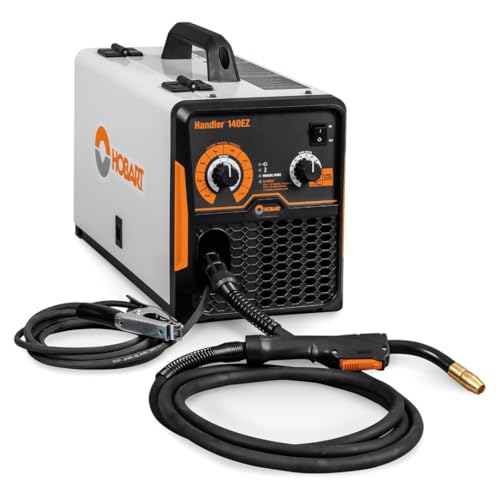
A 120V wire-feed welder with knob-based EZ Mode setup, rated by Hobart for mild steel from 24 gauge to 3/16 in. and spool gun ready for aluminum.
According to Hobart, the Handler 140EZ runs on 110/115/120V power, with an amperage range of 30A to 140A and a rated output of 90A at a 30% duty cycle. It welds with flux-cored or solid wire, and EZ Mode knobs set the parameters with a turn of each knob. Hobart lists a built-in gas solenoid and a dual-gauge regulator with hose, but no gas. It suits sheet metal, brackets, small repairs and similar jobs. The limit is thickness, with 3/16 in. as the stated ceiling. Details are in our Handler 140EZ profile.
Room to Grow: Hobart Handler 210i
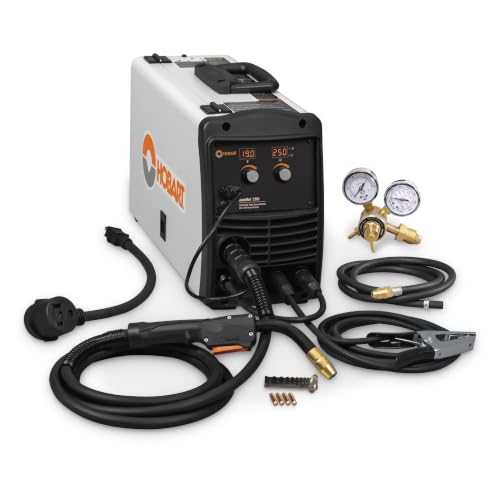
A dual-voltage 120V/240V MIG and flux-cored welder that Hobart rates for mild steel up to 3/8 in., for readers who want one machine to last.
The Handler 210i connects to 120V or 240V receptacles without tools, according to Hobart, and handles 24 gauge to 3/8 in. mild steel. At 120V it is rated 45A at 100% on a 15A circuit and 90A at 25% on a 20A circuit. At 240V the rating is 210A at 25%. It weighs 26 lb and is spool gun ready. It fits a beginner who has the budget to buy once and may eventually need thicker steel or aluminum. Read the Handler 210i profile.
Guided Setup: Millermatic 211 PRO
A 120V/240V MIG and flux-cored welder from Miller with Auto-Set parameter suggestions and pulsed MIG, for beginners who would rather not guess at settings.
Miller says the 211 PRO’s Auto-Set feature recommends the correct parameters from the material, wire and thickness you enter, so welders of all skill levels can get going. A 7-inch color display shows the settings, and BeadVision graphically shows how setting changes affect penetration and bead profile. Miller also lists Dyna-Pulse pulsed MIG for lower heat input on thin material. It weighs 35 lb. According to Miller it welds 24 gauge to 3/16 in. steel on 120V and up to 3/8 in. on 240V. See the Millermatic 211 PRO profile.
Gasless and Very Light: A Note on the WELD-PAK 90i FC
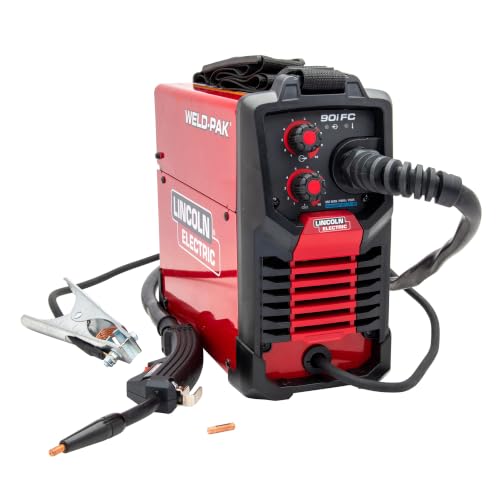
A 15 lb, 120V gasless flux-cored welder for gates, fences and outdoor repairs, with two-knob controls and no gas bottle to buy.
If your list is gates, fences and outdoor repairs on 120V, the Lincoln Electric WELD-PAK 90i FC is a 15 lb flux-cored welder that needs no gas. Lincoln lists flux-cored welding up to 120A and 1/4 in. It is not suited to thin sheet metal.
What to Buy Besides the Welder
Miller reminds first-time buyers that the welder is not the whole cost: welding protection, gas and consumables add up. A starter list:
- An auto-darkening welding helmet with the right shade. OSHA’s rule at 29 CFR 1910.133 requires eye and face protection that meets ANSI Z87.1, and 1910.252 has the filter lens shade table. Wear safety glasses under the helmet.
- Flame-resistant gloves and clothing, with long sleeves, leather boots and no synthetic fabrics that melt. Keep flammables out of the work area, since sparks and spatter cause fires.
- Ventilation or local fume extraction. OSHA’s fume fact sheet says welding outdoors or in an open space does not guarantee adequate ventilation, and says stainless steel can produce hexavalent chromium fume. Galvanized and coated metals call for extra care.
- Shielding gas, a regulator and a cart if you use solid wire. For steel, Miller says a 75% argon and 25% CO2 mix gives the least spatter and best bead appearance.
- Wire, contact tips, a wire brush, a chipping hammer, clamps and scrap steel for practice.
- A fire extinguisher within reach, as part of keeping the work area safe.
Practice Before the First Real Project
Miller’s automotive guide suggests completing practice welds on scrap metal similar to the material and project before the real job. Clean the metal and make sure the work clamp has a good connection. Sit the joint where you can see it, and listen: Miller says a steady sizzling-bacon sound means the wire stickout is right. If the arc sounds irregular, check stickout first.
Bottom Line
For a beginner, start with a wire-feed machine and choose the power and thickness you expect to need. The Hobart Handler 140EZ keeps things simple on a household outlet, the Handler 210i gives headroom on 240V, and the Millermatic 211 PRO adds guided setup and pulsed MIG. Budget for a helmet, gloves, ventilation and gas, and have a licensed electrician install any 240V receptacle. Compare all eight in our welder ranking, or see the aluminum guide if aluminum is on your list.
Sources
- Miller: Buying Your First Welder
- Miller: MIG Basics for Automotive Welding Repair
- Hobart Handler 140EZ official product page
- Hobart Handler 210i official product page
- Millermatic 211 PRO official product page
- Lincoln Electric WELD-PAK 90i FC product information
- Miller: How to Successfully MIG Weld Aluminum
- OSHA Fact Sheet: Controlling Hazardous Fume and Gases during Welding
- OSHA 29 CFR 1910.133 Eye and face protection
- OSHA 29 CFR 1910.252 General requirements for welding, cutting and brazing
Frequently asked questions
What is the easiest type of welding for a beginner?
Miller says MIG is the easiest welding process to learn, with high travel speeds, better control on thinner metals and clean welds with no slag. Flux-cored uses the same wire-feed equipment without gas and is more forgiving on dirty or rusty metal. Miller calls TIG comparatively more complex and difficult to master, and stick harder to learn, particularly striking and holding an arc.
Should my first welder be 120V or 240V?
It depends on the metal you weld. A 120V machine plugs into a household outlet and suits thin steel. Hobart lists its 120V Handler 140EZ for mild steel up to 3/16 in., while its dual-voltage Handler 210i reaches 3/8 in. on 240V. A new 240V receptacle must be installed by a licensed electrician.
Do I need shielding gas?
Only for solid-wire MIG. Self-shielded flux-cored wire needs no gas, which Miller says helps outdoors and in wind. Gas-shielded MIG gives cleaner welds with no slag, and for steel Miller points to a 75% argon and 25% CO2 mix. A gas cylinder and regulator are extra costs, and none of the machines in this guide include the gas.
What else do I need to buy besides the welder?
Miller tells first-time buyers to budget for welding protection (helmet, gloves, jacket) plus gas and consumables. In practice that means an auto-darkening helmet, flame-resistant gloves and clothing, safety glasses, a wire brush and chipping hammer, wire, contact tips and scrap steel to practice on.
Is welding in a closed garage safe?
Welding fume is hazardous. OSHA says welding outdoors or in an open work space does not guarantee adequate ventilation, and recommends general ventilation or local exhaust that pulls fume away from your breathing zone. Never weld in confined spaces without ventilation, and keep flammables well away from sparks.
Can a beginner weld aluminum?
It is harder than steel. Miller says MIG on aluminum needs 100% argon and usually a spool gun, and suits 14 gauge and heavier, while AC TIG is more demanding to learn. Start on steel, then see our aluminum welder guide.