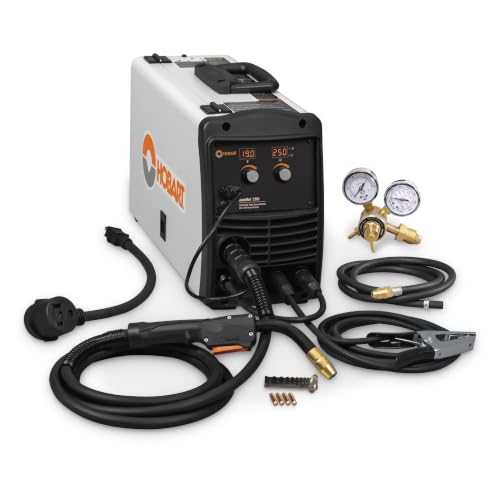
The Hobart Handler 210i is a dual-voltage MIG welder from Hobart. It plugs into 120V or 240V power, welds mild steel from 24 gauge up to 3/8 in., and is built around one process family: solid-wire MIG with shielding gas and flux-cored wire without it. This profile covers what Hobart publishes about the machine, how to read its duty cycle numbers, where it fits next to other welders, and what you still have to buy to use it safely. For where it sits among eight welders, see our welder ranking for 2026.
All specs below come from Hobart’s own product page for the Handler 210i (item 500588). Where Hobart does not state a figure, we do not either.
What Hobart Says About the Handler 210i
According to Hobart:
- It is a dual-voltage 120V/240V MIG welder that handles 24 gauge to 3/8 in. mild steel.
- Input voltage is 120/240V at 60 Hz, single-phase, and the output is DC.
- The amperage range is 30A to 210A, with a maximum open-circuit voltage of 72 VDC.
- Rated output at 120V on a 15A circuit is 45A at 16.3 VDC and a 100% duty cycle. On a 20A circuit it is 90A at 18.5 VDC and 25%. At 240V it is 210A at 24.5 VDC and 25%.
- Net weight is 26 lb, with a 20 in. length, 7.3 in. width and 11.75 in. height, and a carry handle.
- Wire diameter ranges are 0.024 to 0.035 in. for solid steel and stainless, and 0.03 to 0.045 in. for flux-cored.
- The spool hub takes 4 in. or 8 in. spools.
- The metal thickness table lists mild steel from 24 gauge (0.5 mm) to 3/8 in. (9.5 mm) and aluminum from 18 gauge (1.2 mm) to 1/4 in. (6.4 mm).
- It is generator compatible. Hobart says it will give full output from a generator providing 9,500 continuous and 11,000 peak watts, with limited output on smaller generators.
- It ships with a 10 ft HR-100 gun, a 10 ft work cable with clamp, a welding guide and material thickness gauge, a Quick Select drive roll, a built-in gas solenoid and a dual-gauge regulator with gas hose, an owner’s manual and contact tips.
- Hobart’s 5/3/1 Industrial Warranty applies. Read the warranty page for what each number covers.
How to Read the Duty Cycle Numbers
Duty cycle is the share of a ten-minute period that a welder can run at a given output before it needs to cool. The Handler 210i’s numbers show why input power matters so much.
At 120V on a 15A circuit, Hobart rates 45A at a 100% duty cycle. That is a continuous-duty rating, but 45A is low output, which suits thin sheet metal. On a 20A circuit the rating rises to 90A at 25%, meaning about two and a half minutes of welding in ten at that output. At 240V, Hobart rates 210A at 25%, the top of the range.
Miller, another maker, gives a useful rule of thumb in its welder-buying guide: about one amp of output per .001 in. of material thickness. By that rule, 3/8 in. steel in a single pass wants well over what a 120V circuit can supply, which is why the 3/8 in. figure goes with 240V power. If most of your work is sheet metal, fenders, brackets and thin tube, the 120V ratings are enough. If you plan to weld 1/4 in. and thicker plate, plan on 240V.
The new 240V receptacle is the part to hand off. The makers’ manuals say to have a qualified electrician connect the receptacle, and that applies here: a licensed electrician should install any new 240V circuit or receptacle, and this page will not give wiring details.
Aluminum With a Spool Gun
Hobart calls the Handler 210i spool gun ready, with easy setup for aluminum and no additional interface. Its accessories list includes the SpoolRunner 100 direct plug-in spool gun, rated at 150A with a 10 ft cable, for smoother aluminum MIG welding.
Two points are worth knowing before you count on this. First, the spool gun is a separate purchase. Second, aluminum is a different job from steel. Miller’s aluminum MIG guide says aluminum needs 100% argon, not a steel mix, recommends a flow of 20 to 30 cubic feet per hour, and says aluminum thicknesses suitable for MIG are 14 gauge and heavier. Thinner aluminum may call for pulsed MIG or AC TIG equipment, which this machine does not offer. Hobart’s own table lists aluminum from 18 gauge on this machine, so treat thin aluminum as a stretch and plan your first aluminum jobs on heavier stock. Our aluminum welder guide lays out the choices.
Who the Handler 210i Fits
- Garage and auto repair users who want one machine for sheet metal and frames. Hobart lists auto repair, farm and ranch, and racing, customizing and restoring among its industries.
- People starting with a 120V outlet who may add 240V later. The dual-voltage design lets one machine cover both, provided the 240V receptacle gets installed properly.
- Welders who prefer solid wire with gas for clean beads and flux-cored wire outdoors, where wind can blow shielding gas away. Miller’s buyer guide notes that self-shielded flux-cored welding does not need shielding gas, which helps outdoors or in wind.
- Hobbyists who might want aluminum later, since the machine is spool gun ready.
For first-time buyers, see our beginner welder guide.
Who Should Look Elsewhere
- You want stick or TIG. The Handler 210i is a wire-feed MIG machine only. For a machine that also does stick and DC TIG, the Lincoln Electric POWER MIG 215 MPi is a multi-process option in our ranking.
- You need AC TIG for thin aluminum. The machines on our list with AC TIG are the Miller Multimatic 220 AC/DC, the Lincoln Square Wave TIG 200 and the AHP AlphaTIG 203Xi.
- You will only ever weld thin steel on 120V. The smaller Hobart Handler 140EZ is a 120V-only machine rated for mild steel up to 3/16 in.
- You want pulsed MIG for thin material. That is a feature of the Millermatic 211 PRO in our ranking, not of this machine.
Setup, Consumables and Gear
Hobart’s page says shielding gas is not included, and the machine has a built-in gas solenoid and a dual-gauge regulator with a gas hose. For steel, Miller’s auto repair guide says a 75% argon and 25% CO2 mix gives the least spatter and the best bead appearance, while 100% CO2 gives deeper penetration with more spatter and a rougher bead. The Quick Select drive roll has three grooves, two for different solid wire sizes and one for flux-cored wire.
Wire size matters on thin metal. Miller’s sheet metal guidance says to use the smallest wire diameter possible, with .023 or .024 in. wire for most light-gauge work. The Handler 210i’s drive roll covers .024 in. wire, so this machine can be set for body panels. The same Miller guidance warns against welding thin sheet metal with flux-cored wire, which puts more heat into the base metal.
Safety gear is not included either. OSHA’s eye and face protection rule, 29 CFR 1910.133, requires protection that meets ANSI Z87.1, and its welding standard, 1910.252, has the filter lens shade table. In practice that means an auto-darkening helmet with the right shade, safety glasses under it, flame-resistant gloves and clothing, and nothing flammable near the work. OSHA’s welding fume fact sheet says that welding outdoors does not guarantee adequate ventilation, and that stainless steel can produce hexavalent chromium fume, so use ventilation or local exhaust and keep your head out of the plume. Flux-cored welding is listed by OSHA as the highest fume producer among common arc processes, which matters in a closed garage.
Specs at a Glance
| Item | According to Hobart |
|---|
| Processes | MIG and flux-cored |
| Input | 120/240V, 60 Hz, single-phase |
| Amperage range | 30A to 210A |
| Mild steel | 24 gauge to 3/8 in. |
| Aluminum | 18 gauge to 1/4 in., with spool gun |
| Weight | 26 lb |
| Spool size | 4 in. or 8 in. |
| Gun | 10 ft HR-100 |
Bottom Line
The Handler 210i is a focused tool. It does MIG and flux-cored welding on steel, can take a spool gun for aluminum, and moves between 120V and 240V power so it can grow with the shop. It does not offer stick, TIG or pulsed MIG. If wire welding is the whole plan, its published ratings and 26 lb weight make it a practical machine for repair, farm and fabrication work, provided you budget for gas, a helmet, gloves, ventilation and, for thick steel, a 240V receptacle installed by a licensed electrician. Use the button on this page to see the current listing and confirm the exact kit before ordering. For help picking among all eight, see the full ranking.
See price on Amazon
Sources