We earn a commission if you buy through our links, at no extra cost to you.
Best Welder for Auto Body and Car Work
Welding car panels, floor pans and exhaust: thin wire, 75/25 gas, why to skip flux-cored on sheet metal, stitch welding and pulsed MIG, with three models.
At a glance
For car body work, use a gas MIG welder with .023 or .024 inch wire and 75/25 gas, and avoid flux-cored on thin panels. The Millermatic 211 PRO adds Auto-Set and pulsed MIG for low heat input. The Hobart Handler 210i and Lincoln POWER MIG 215 MPi cover thicker frame work on 240V.

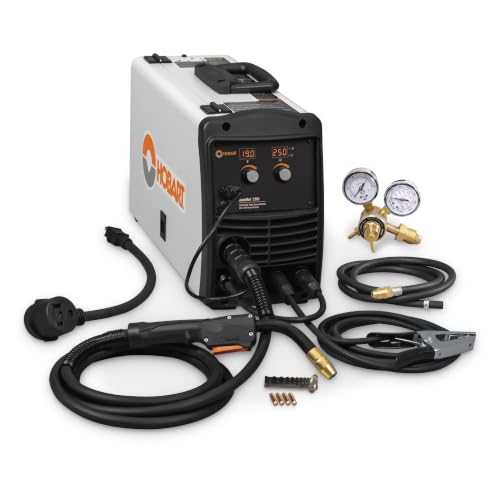

Car work asks a welder to do two opposite things. Body panels, floor pans and patches are thin steel that burns through if you give it too much heat. Frames, suspension mounts and brackets are heavier steel that needs real penetration. The right welder and setup keep the first job from ruining the panel and the second from failing. This guide covers wire, gas, technique and the machines on our list that suit car work. For the full field, see our welder ranking.
Specs and technique here come from Miller’s automotive and sheet metal guides, and from the makers’ pages. We do not list prices; use the Amazon buttons for current pricing.
What Thin Sheet Metal Demands
Miller’s sheet metal guide states the goal plainly: avoid warping, burn-through and excessive heat-affected zones while keeping enough strength in the weld. Short-circuit transfer MIG, TIG and pulsed TIG give the most control over heat. The rules that follow are Miller’s.
- Use the smallest wire diameter possible. Small wire takes less heat to melt, gives more control over the bead and is easier to recover from mistakes. Miller says .023 or .024 in. wire is best for body panels and material up to 1/16 in., .030 in. is better for 20 gauge to 1/8 in., and .035 in. is good for 16 gauge to 1/4 in.
- Use an argon-based gas. A 75% argon and 25% CO2 blend gives the least spatter and best bead appearance and will not promote burn-through on thin metals. Pure CO2 gives deeper penetration but more spatter and a rougher bead.
- Avoid flux-cored on thin panels. Miller says not to weld sheet metal with flux-cored wires, which put more heat into the base metal.
- Use a common mild steel wire. Miller names ER70S-6 as a wire that wets out nicely.
Technique That Saves Panels
Miller’s automotive guide says to practice on scrap similar to the real material first, and to clean the surface and check the work clamp connection. For thin panels:
- Push the gun (point it away from the puddle). Miller says pushing gives lower penetration and a wider, flatter bead, and recommends it for sheet metal and body panels. Pulling is most often used for thicker material like frames.
- Stitch or spot-stitch weld. On thin body panels, a spot stitch weld while moving around the panel keeps heat soaking and warping to a minimum. Miller’s skip welding technique spreads heat evenly with intermittent welds.
- Fit-up is everything. Miller says that on 20 to 24 gauge butt joints, a gap of even 1/16 in. invites burn-through. Plug welds can replace a solid bead where strength allows. A copper or aluminum backing bar clamped behind the joint dissipates heat.
- Keep wire stickout at 1/4 to 3/8 in. Miller says to listen for a steady sizzling-bacon sound, and to use a slightly longer stickout in tight spots like inner panels, pillars, roof rails and floor pans.
Floor Pans, Frames and Overhead Work
Flat-position welds are common on body panels, floor pans and some frame repair, according to Miller. Vertical welds on frame sections and pillars call for reducing voltage and amperage by 10 to 15 percent from flat settings. Overhead welds, such as on the exhaust and the underside of the car, are the most difficult position. Miller advises reducing parameters at least 10 to 15 percent, keeping a faster travel speed and using smaller stitch welds to reduce puddle droop. Welding under a car puts you beneath falling spatter, so wear flame-resistant gear and keep flammables, fuel and fluids away from the work. Do not weld on or near fuel system components.
Exhaust Pipe
Miller says stainless steel is used in exhaust systems, fuel tanks and other parts that need corrosion resistance. For 304 stainless, Miller lists ER308, ER308L and ER308LSI wires as compatible and says 316L needs a 316L wire, with a tri-mix gas of 90% helium, 8% argon and 2% CO2. OSHA warns that stainless steel can release hexavalent chromium fume, which is highly toxic, so use ventilation or local fume extraction and keep your face out of the plume. Mild steel exhaust uses the same thin-metal rules as body panels.
Millermatic 211 PRO: Auto-Set and Pulsed MIG for Thin Metal
A 120V/240V MIG welder with Auto-Set parameters and pulsed MIG for lower heat input, which fits thin panels and heavier frame work in one machine.
Miller lists automotive among the applications of the 211 PRO, and its auto repair guide names the machine as a professional option that welds 24 gauge to 3/8 in. in a single pass. Its spec sheet lists 24 gauge to 3/16 in. steel on 120V and up to 3/8 in. on 240V. Miller says Dyna-Pulse provides lower heat input that reduces distortion on thin materials and less spatter. Auto-Set recommends parameters from wire diameter and thickness, and the machine weighs 35 lb. Read the Millermatic 211 PRO profile.
Hobart Handler 210i: Auto Repair on 120V or 240V
A dual-voltage MIG and flux-cored welder that Hobart rates from 24 gauge to 3/8 in. mild steel, with a drive roll for .024 in. solid wire for panels.
Hobart lists auto repair and racing, customizing and restoring among the industries for the Handler 210i, and automotive welding as an application. Its Quick Select drive roll supports .024 in. solid wire, and Hobart says the interface offers fine control for less spatter and better bead appearance. It lacks pulsed MIG. Hobart rates it at 210A at 25% on 240V. It weighs 26 lb, and the Handler 210i profile has the full specs.
Lincoln Electric POWER MIG 215 MPi: When the Frame Matters Too
A 120V/230V multi-process machine rated 215A at 30% on 230V, for heavier frame and suspension work alongside panel repair.
Lincoln’s manual lists solid MIG wire from .025 to .035 in., MIG, flux-cored, stick and DC TIG, and a Magnum PRO 175L gun. Its 230V rating is 215A at 24.8V and 30% duty cycle, and it weighs 48 lb. It fits a car builder who also welds heavier brackets and plans to keep one machine for years. See the POWER MIG 215 MPi profile.
Which Machine for Which Car Job?
- Mostly body panels and patches: the Millermatic 211 PRO, for pulsed MIG and guided setup. The 120V rating covers thin steel.
- Panels plus frame repair with a simpler setup: the Hobart Handler 210i on 240V.
- Frames, trailer hitches and brackets with some panel work: the POWER MIG 215 MPi.
- Not suited: gasless-only machines like the Lincoln WELD-PAK 90i FC, since Miller advises against flux-cored on sheet metal.
If this is your first welder, see our beginner guide. If your car has aluminum panels, see our aluminum welder guide.
Safety on Car Projects
OSHA’s rule at 29 CFR 1910.133 requires eye and face protection that meets ANSI Z87.1, and 1910.252 has the filter lens shade table. Use an auto-darkening helmet, flame-resistant gloves and clothing, and ventilation. OSHA lists zinc and chromate coatings among the sources of metals in welding fume, so clean coatings off the joint before welding and ventilate well. OSHA says welding outdoors does not guarantee adequate ventilation. Any new 240V receptacle needs a licensed electrician.
Bottom Line
For car work, choose a gas MIG machine, a small-diameter wire and 75/25 gas, then weld in short stitches to manage heat. The Millermatic 211 PRO suits thin panels best because of its pulsed MIG, the Handler 210i offers a simpler dual-voltage approach, and the POWER MIG 215 MPi handles heavier frame work. Compare them with the rest of the field in our welder ranking.
Sources
- Miller: MIG Basics for Automotive Welding Repair
- Miller: Successfully Welding Sheet Metal with MIG and TIG
- Miller: Buying Your First Welder
- Millermatic 211 PRO official product page
- Millermatic 211 PRO spec sheet
- Hobart Handler 210i official product page
- Lincoln Electric POWER MIG 215 MPi operator’s manual
- Lincoln Electric WELD-PAK 90i FC product information
- OSHA Fact Sheet: Controlling Hazardous Fume and Gases during Welding
- OSHA 29 CFR 1910.133 Eye and face protection
- OSHA 29 CFR 1910.252 General requirements for welding, cutting and brazing
Frequently asked questions
What size wire is best for auto body panels?
Miller says .023 or .024 in. wire is best for body panels and material up to 1/16 in., .030 in. suits 20 gauge to 1/8 in., and .035 in. suits 16 gauge to 1/4 in. Its sheet metal guidance says to use the smallest wire possible, since small wire takes less heat to melt and gives more control.
What gas should I use for car body work?
Miller says a 75% argon and 25% CO2 blend gives the least spatter and best bead appearance, and will not promote burn-through on thinner metals. 100% CO2 gives deeper penetration but more spatter and a rougher bead.
Can I use a flux-cored welder on car body panels?
Miller says not to attempt to weld thin materials like sheet metal with flux-cored wires, which put more heat into the base metal. Flux-cored suits thicker, dirtier material and outdoor work, and a gasless-only machine such as the Lincoln WELD-PAK 90i FC is not suited to thin panels.
How do I keep thin panels from warping or burning through?
Miller recommends skip welding (a series of intermittent or stitch welds), spreading the heat around the panel, a push technique, a tight fit-up and, if needed, a copper or aluminum backing bar. Spot stitch welds while moving around the panel keep heat soak and warping to a minimum.
What welder can do exhaust pipe work?
Miller says stainless steel is used in the fabrication of exhaust systems. A MIG welder with a stainless wire and the right gas can do it, though Miller recommends a tri-mix gas for 304 and 316L stainless. Overhead welds under the car are the most difficult position, so reduce settings and use stitch welds.
Do I need 240V for car work?
Not for body panels. Miller lists body panels as thin material, and the 120V ratings of the Millermatic 211 PRO cover 24 gauge to 3/16 in. steel. Frames and thicker structural parts are where 240V helps. A licensed electrician should install any new 240V receptacle.