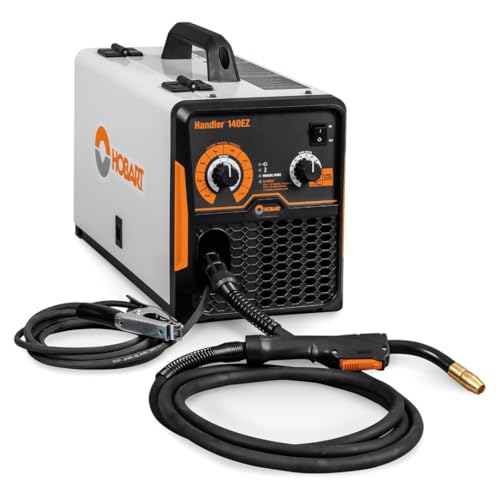
The Hobart Handler 140EZ is a small wire-feed welder that runs on 120V power. Hobart describes it as a durable, portable machine for auto repair, shop and farm work, rated for mild steel up to 3/16 in. with flux-cored or MIG wire. It is the lighter-duty sibling of the Handler 210i in our ranking, and it makes sense when thin steel on a household outlet is the whole job. This profile covers the specs Hobart publishes, what the duty cycle means in practice, what you still need to buy, and who should pick something bigger. For the whole field, see our welder ranking for 2026.
All specs below come from Hobart’s own product page for the Handler 140EZ (item 500582). Hobart’s page does not list the weight, so we do not give one.
What Hobart Says About the Handler 140EZ
According to Hobart:
- It is a portable 120V wire-feed welder that welds up to 3/16 in. mild steel with flux-cored or MIG wire.
- Input voltage is 110/115/120V at 60 Hz, single-phase, with DC output and a built-in wire feeder. It includes a power cord with plug.
- The amperage range is 30A to 140A, with a maximum open-circuit voltage of 30 VDC.
- Rated output is 90A at a 30% duty cycle.
- Wire feed speed is 15 to 360 IPM.
- Wire diameter ranges are 0.024 to 0.035 in. for solid steel and stainless, and 0.03 to 0.035 in. for flux-cored.
- Mild steel thickness runs from 24 gauge (0.8 mm) to 3/16 in. (4.8 mm).
- The spool hub accommodates 4 in. or 8 in. spools.
- Features include EZ Mode knobs, a Quick Select drive roll with three grooves, an industrial cast aluminum wire drive system and a spool gun ready design for aluminum.
- It ships with a 10 ft HR-100 gun, a 10 ft work cable with clamp, .030 in. contact tips, a built-in gas solenoid valve and dual-gauge regulator with gas hose, a welding guide and material thickness gauge, and an owner’s manual.
- Hobart does not include shielding gas or safety equipment.
- The warranty is Hobart’s 5/3/1 Industrial Warranty.
Hobart’s page lists the Handler 140EZ’s applications as aluminum welding, automotive welding, car restoration, garage and shop work, metal art, stainless steel and welding projects, and it classifies the machine as a DIY and hobby welder.
Reading the Duty Cycle
Duty cycle is how long a welder can run at a given output out of a ten-minute period. Hobart’s rating of 90A at 30% means about three minutes of welding at 90A, followed by seven minutes of cooling, at the rated point. Miller explains that duty cycle rises as amperage falls: at lower settings the machine can weld for longer stretches.
For the work this machine suits, the numbers are not a handicap. In a garage or shop, Miller says, the operator is usually using lower amperages and stopping frequently, so a lower duty cycle covers most jobs. Sheet metal, brackets and light repairs run at well under the 90A rating. The limit shows up when you try to weld near the top of the thickness range, 3/16 in., in long continuous runs. Miller’s rule of thumb is about one amp per .001 in. of thickness, which puts 3/16 in. steel at around 190A, above what this machine’s 140A top end delivers in one pass. That is why joints in thicker steel need multiple passes or a larger machine. If you expect to weld 1/4 in. and thicker regularly, look at a 240V welder such as the Hobart Handler 210i.
Setup: Gas or Flux-Cored
You can run the Handler 140EZ two ways.
Solid wire with shielding gas gives a clean bead with no slag. Miller’s welder-buying guide calls MIG the easiest process to learn, with better control on thinner metals and clean welds with no slag to clean. The Handler’s built-in gas solenoid valve and dual-gauge regulator with hose are included, but the gas is not. For steel, Miller’s auto repair guide says a 75% argon and 25% CO2 mix gives the least spatter and the best bead appearance.
Flux-cored wire without gas works outdoors, in wind and on dirty or rusty material, according to Miller, and allows out-of-position welding. It makes more smoke, though. OSHA’s fume fact sheet ranks flux-cored welding first among the common arc processes in fume production. On thin sheet metal, Miller says not to use flux-cored wire because it puts more heat into the base metal. For body panels, use solid wire with gas and a small diameter: Miller says .023 or .024 in. wire is best for body panels and material up to 1/16 in. The Handler 140EZ’s drive roll groove for .024 in. wire is a good match.
Aluminum With the SpoolRunner 150
Hobart calls the 140EZ ready for aluminum with no additional interface, and its accessory list names the SpoolRunner 150 plug-in spool gun for smooth aluminum MIG. That spool gun is not in the box.
Miller’s aluminum guide gives the rules that matter. Aluminum needs 100% argon, with a flow of 20 to 30 cubic feet per hour. MIG suits aluminum of 14 gauge and heavier, and thinner aluminum may need pulsed MIG or AC TIG. A spool gun keeps a small spool of soft aluminum wire close to the weld, which avoids bird-nesting in a long liner. On a 120V machine rated 90A at 30%, expect to be limited to thinner aluminum. See our aluminum welder guide for the full comparison with AC TIG machines.
Safety Basics
A small welder still makes an arc that can injure eyes and skin, and fumes that can injure lungs. OSHA’s rule at 29 CFR 1910.133 requires eye and face protection that meets ANSI Z87.1, and 1910.252 sets out the filter lens shade table, so buy an auto-darkening helmet with the right shade and wear safety glasses under it. Add flame-resistant gloves and clothing, keep flammables away from sparks, and ventilate. OSHA’s fact sheet notes that welding outdoors does not guarantee adequate ventilation, and that stainless steel can produce hexavalent chromium fume. Use local fume extraction where you can.
Household circuits vary. Welders draw heavy current, and a new receptacle, if you need one, should be installed by a licensed electrician. This page does not give wiring, breaker or wire-gauge instructions.
Who the Handler 140EZ Fits
- Home garage users with 120V power only. It is a plug-in machine that suits sheet metal, small brackets, gates and similar jobs.
- Auto hobbyists working on thin panels, using solid wire with gas.
- Beginners who want simple controls. Hobart’s EZ Mode sets parameters with a turn of each knob. The beginner welder guide puts it next to other first machines.
- Light farm and ranch repair with flux-cored wire outdoors.
Who Should Look Elsewhere
- You weld 1/4 in. and thicker steel. Choose a 240V machine.
- You want stick or TIG. This is wire-feed only. See the multi-process machines in our ranking.
- You want to weld aluminum seriously. A 120V machine with a spool gun is limited, and AC TIG is the route for thin aluminum.
- You want a gasless-only start. The Lincoln Electric WELD-PAK 90i FC is a lighter, gasless-only option, though it is limited to flux-cored wire.
Bottom Line
The Hobart Handler 140EZ is a plain, capable 120V wire-feed welder: 30A to 140A, 90A at 30%, mild steel to 3/16 in., spool gun ready, and simple knob controls. It does not stretch into thick steel, stick or TIG. For a garage welder that plugs into a wall outlet and handles sheet metal, light fabrication and repairs, it matches what Hobart claims for it. Plan the extras: shielding gas, wire, a helmet, gloves and a way to ventilate. Use the button below to see the current listing and confirm what ships in the box.
See price on Amazon
Sources