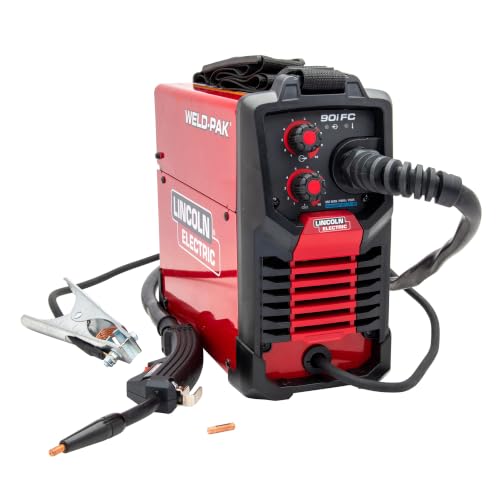
The Lincoln Electric WELD-PAK 90i FC is the smallest and simplest welder in our ranking. It weighs 15 lb, plugs into a household 120V receptacle, and does one thing: flux-cored wire welding without shielding gas. That narrow focus is both its appeal and its limit. This profile covers what Lincoln publishes, how the numbers translate to real jobs, the safety points that come with flux-cored welding, and who should choose a bigger machine instead. For the whole field, see our welder ranking for 2026.
The specs come from Lincoln’s product information sheet for the K5255-1 (publication E7.38, 02/24). Lincoln’s own product page blocks automated access, so this profile relies only on that document, and it states nothing that document does not say.
What Lincoln Says About the WELD-PAK 90i FC
According to Lincoln’s product information sheet:
- It is a lightweight, ultra-portable welder that connects to 120V power and is described as an excellent choice for flux-cored welding.
- Input is 120V, single-phase, 60 Hz, with an input current of 20A at rated output.
- Rated output is 90A at 21V and a 30% duty cycle. The output range is 20 to 120A.
- Flux-cored welding is listed up to 120A at a maximum thickness of 1/4 in.
- Wire feed speed is 20 to 200 ipm.
- Net weight is 15 lb (6.8 kg), with dimensions of 11 in. high, 5.5 in. wide and 13 in. deep.
- Controls are two knobs, for wire speed and voltage, with built-in indicators. A fast-feed wire loading switch helps load wire.
- The drive roll is knurled for solid and flux-cored feeding. The listed drive roll is for .030 to .035 in. flux-cored wire.
- The case is 18 gauge metal. The front is impact resistant and vented for pull-through fan cooling, and a thermal protection LED shows overheating. A quarter-turn spool tensioner allows toolless wire changes.
- A WP100L gun with a 6 ft cable is attached. The gun connection is hard-wired.
- Included are the gun, a .030 in. contact tip, a .035 in. contact tip, a gasless nozzle for Innershield welding, a drive roll for flux-cored welding and an instruction manual.
- Lincoln lists applications as automotive, home, construction, lawn and garden, powersports, and maintenance and repairs, and offers an optional welding cart (K2275-3).
Reading the Numbers
90A at 30%. Duty cycle is the share of a ten-minute period the welder can run at its rated output. At 90A and 30%, you get about three minutes of welding in ten at that setting, then the machine needs to cool. Miller notes that a shop or garage user usually works at lower amperages and stops frequently, so a low duty cycle covers most small jobs. Fence repair, gate hinges, brackets and trailer fixes tend to be short welds.
Thickness. Lincoln lists flux-cored welding up to 1/4 in. at the 120A top end of the range. Miller offers a rule of thumb of about one amp per .001 in. of thickness, which suggests that 1/4 in. needs more output than this machine can offer in a single pass. In practice, multiple passes and good joint preparation are how small machines work on heavier steel, and a 90A rating suits material well under that top thickness. If your list of projects includes 1/4 in. plate or heavier, step up to a 240V machine such as the Hobart Handler 210i.
120V circuits. The 20A input current at rated output means the machine needs a capable circuit. Check the receptacle you intend to use. A licensed electrician should install any new receptacle, and this page does not give wiring, breaker or wire-gauge details.
What Flux-Cored Means
Flux-cored arc welding is similar to MIG in that it feeds a wire continuously, but the wire has a core of flux that shields the arc, so no gas bottle is needed. Miller’s buyer guide says flux-cored is more forgiving on dirty or rusty material, suitable for out-of-position welding, deep in penetration for thick sections, and good for outdoor and windy conditions. It also notes both MIG and flux-cored can join materials as thin as 26 gauge. Those are Miller’s general descriptions of the process, not claims about this machine.
The tradeoffs are fume, spatter and slag. OSHA’s fume fact sheet orders common arc processes by decreasing fume production, and flux-cored comes first, ahead of stick, MIG and TIG. The finished weld usually needs cleaning. And on thin metal, Miller advises against flux-cored wire, because it puts more heat into the base metal, and recommends .023 or .024 in. solid wire with 75/25 argon and CO2 for body panels. For auto body panels and exhaust work, our auto body welder guide points toward gas MIG machines instead.
Safety for a Small Welder
A 15 lb machine still produces an arc that can injure. OSHA’s rule at 29 CFR 1910.133 requires eye and face protection that meets ANSI Z87.1, and 1910.252 includes the filter lens shade table. Use an auto-darkening helmet with the right shade, and wear flame-resistant gloves and clothing, with no flammables near the work, since sparks and spatter start fires. Flux-cored welding produces a lot of fume, so ventilate. OSHA says welding outdoors or in an open space does not guarantee adequate ventilation, and recommends local exhaust that draws fume away from the breathing zone. Welding galvanized or stainless steel adds hazards of its own, and stainless can release hexavalent chromium fume.
Who the WELD-PAK 90i FC Fits
- Homeowners with light repair lists. Gates, fences, lawn equipment, brackets and similar items on mild steel.
- People who need a machine they can carry. Fifteen pounds with a shoulder strap is easy to put in a truck bed.
- Outdoor or windy conditions. No gas bottle to blow away.
- Absolute beginners on 120V power who want the simplest possible controls. See our beginner guide for how it compares with machines that take gas.
Who Should Look Elsewhere
- Thin sheet metal and auto body. A gas MIG machine with .023 or .024 in. wire gives better heat control.
- Aluminum. Lincoln lists no spool gun for this machine.
- Thick steel or frequent heavy use. The 90A, 30% rating and 1/4 in. ceiling are the limits.
- Anyone who wants to grow into MIG with gas. The Hobart Handler 140EZ is a 120V machine that takes gas and a spool gun.
Bottom Line
The WELD-PAK 90i FC is a compact gasless flux-cored welder: 15 lb, 120V, 90A at 30% and a 120A maximum. It does light repairs and outdoor jobs on mild steel well within its listed limits and nothing beyond them. If that is your whole list, it is simple and portable. If you may want to weld thin panels, aluminum or thick plate, pick a machine with more range from our full ranking. Use the button to see the current listing on Amazon and confirm what is in the box.
See price on Amazon
Sources